Adnams Copper House Dry Gin

Having started with a taste of the orient I thought the next review ought to be closer to home.  Step forward Copper House Dry Gin – a homegrown product from Suffolk, produced by renowned East Anglian brewer Adnams.  Given that their beer is delicious, they ought to know a thing or two about malted barley – the grain that is used as the base for their gin – so I thought I would give their gin a try.

As you already know, I like to start by tasting the neat gin and I make a point of not looking at the back label or the website for information about botanicals so that I can see what my tastebuds tell me and not be led by the marketing blurb.

So, what does the neat spirit have promise?  The nose is undoubtedly citrus.  Difficult to define exactly, but perhaps a mixture of orange and lemon.  There is also a floral note to it – though I couldn’t pretend to identify it any more precisely than that.  That citrus character is also carried through to the taste but the palate also brings out a definite flavour of spice – and slightly perfumed at that.

Now I allow myself to read what Adnams wants to tell me.  Apparently, there are 6 botanicals: Juniper berries (no surprise there as it is the main botanical in all gins and what makes it taste like gin!), orris root and coriander seeds (both frequently used in gin production), cardamom pod (that will account for the perfumed spice), sweet orange peel (almost all gins include at least one citrus flavour) and hibiscus flower.  The website says that the last one is “the least expected”.  No argument there!  No doubt that is the floral character on the nose that I couldn’t name – perhaps I just don’t know what hibiscus flowers smell like – other than ‘flowery’!

Time to turn it into a proper G&T and see how it tastes then:  The freshness from the citrus elements is still there (perhaps helped by the lime I used as a garnish) but the bitterness of the tonic water (Fevertree once again) really highlighted the perfumed spice.  Again, the cardamom is readily identifiable.

Some facts about the production: The grain is distilled first to produce the original spirit and then the 6 botanicals are added directly to this (ie the London dry gin method) before the whole lot is distilled again in a handmade copper pot still (which is, I guess, where the Copper House name comes from) to produce the final gin which is then brought up to bottling strength – in this case 40% ABV.  It was awarded World’s Best Gin at the International Wine and Spirit Competition though, admittedly, that was back in 2013.

All in all, this is a lovely, very refreshing gin – I think it’s that citrus punch that makes it taste so zingy and fresh, and has a flavour that is distinctive enough to be added to your list of “gins that are slightly different”.  I would certainly buy it again and suggest that you might like to give it a try.

If you do want to get hold of a bottle then you are probably going to have to search for it, and some outlets want to charge you nearly 40 quid!  The best prices I found online were at Waitrose (£26.99) and Master of Malt (£27.25).

If you do try it then please leave a comment to let me know what you think.

This is NOT a sponsored post and all opinions are my own.
Opihr gin review – a taste of the Orient

Opihr gin image

If I am going to review individual gins then I thought I would start with one that really is noticeably different – Opihr.  If you were at all doubtful that all these different gins on the market actually have individual tastes then this should absolutely convince you.  If you drink this and can’t discern any noticeable difference from what you have drunk before then your palate and tastebuds are officially dead and there really is no hope for you!

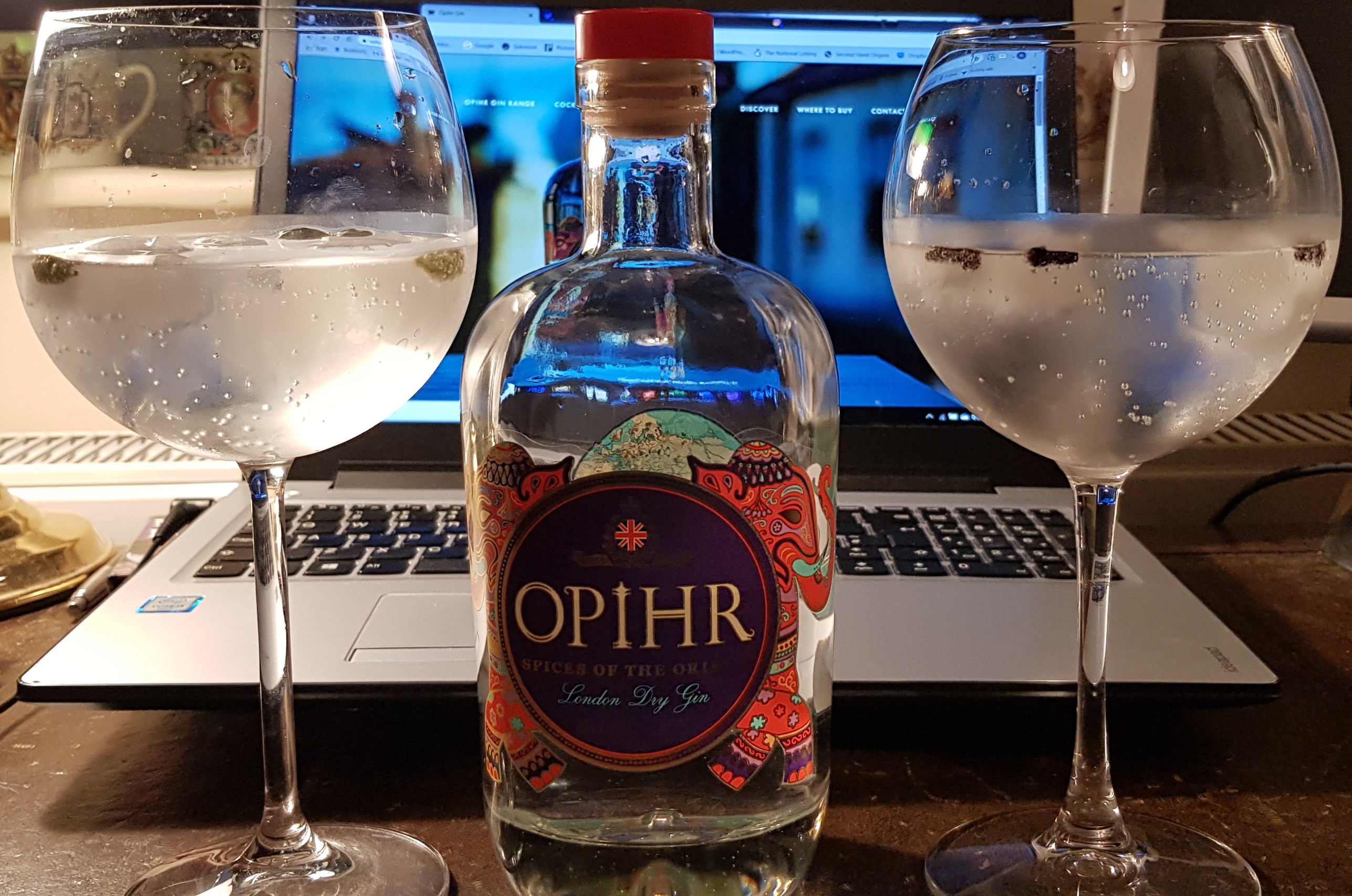
Opihr is a London Dry Gin (that’s a style of gin and not a geographical reference – more on that in a future post) with oriental spices.  Opihr now produce several variants, but this is a review of the ‘original’ offering (see picture above) which is also the one that you are most likely to find on the supermarket shelves.

For any gin, I do like to have a small taste (and I do mean small) neat.  This removes any influence of tonic or garnish and lets you get direct to the flavours in the gin – though I freely admit that some flavours are only brought out when the tonic and garnish are added.  Nevertheless, I find this a good place to start.  Well, just a quick sniff of the neat Opihr tells you that you are in for something very different.  The warm spices are immediately obvious on the nose.  In particular, cardamom and coriander leap out at you and when you take a swig (sorry, gentle sip) they are there in bucket loads on the palate as well.

Adding ice and tonic really wakes up these spice route flavours and instantly make this a gin and tonic like you have never tasted before – and I mean that in a very, VERY good way!  The blurb on the label (and the website) tells you Opihr (pronounced o-peer) was “a legendary region famed for its wealth and riches which prospered during the reign of King Solomon.”  The exact location of Opihr remains a mystery but it is believed to have been in the Orient along the ancient Spice Route.  The botanicals used in this gin include cubeb berries from Indonesia, black pepper from India and coriander from Morocco.  Well, in actual fact, none of those particular ingredients are that unusual in modern gin.  However, whether it is from where they are sourced, or the other botanicals mixed with them or the particular proportions I cannot say, but something makes this exotically spiced gin incredibly distinctive.

So, how do you bring out the best from this riotous carnival of spiced flavours?  Well, my two favourite garnishes with this gin are cardamom or cloves (though not together!).  If you are not sure you would recognise these flavours, cardamom (the glass on the left in the picture) is one of the main spices in pilau rice and if you have ever neglected to keep your eyes open and have ended up chewing on a whole cardamom pod buried in the rice from your favourite Indian restaurant then you will certainly have known about it!  It is like eating raw perfume and can stay with you for hours.  Fortunately, adding these pods to your G&T is perfectly safe because, whilst it flavours it beautifully, they are clearly visible so you are not likely to find one in your mouth without due warning.  Clove, on the other hand (right hand glass), you are most likely to have come across as the flavour in the bread sauce with your roast chicken or turkey.  If you can’t stand bread sauce, but weren’t sure why, best not go for the cloves!  If you don’t have either of these to hand then black peppercorns work well.  Failing that, dried juniper berries and/or a couple of wedges of lime go with pretty much any G&T and certainly won’t let you down here.

As cardamom is one of the botanicals used in this gin then adding some cardamom pods really brings that out.  Take three or four pods, lay them on a kitchen work surface, lay the flat side of a kitchen knife across them and give it a whack with the heel of your hand to crack the pods, thus exposing the seeds, and add them to your iced gin.  If using cloves (my absolute favourite for this gin), then just pop in four or five whole cloves.  Whatever you do, don’t use ground cloves.  That just leaves an unattractive dust on the surface which is unpleasant to drink and doesn’t even noticeably enhance the flavour! Either way, add a suitably bold flavoured tonic (I recommend original Fevertree Indian tonic water – that’s the yellow label) and enjoy.

This is NOT a sponsored post and all the opinions expressed are entirely my own.  However, if you want to find them in cyberspace then Opihr does, of course, have a presence on the usual social media platforms:

www.opihr.com

opihrgin  @OpihrGin Opihr Gin

    instagram icon             twitter icon            facebook icon


How to pour the perfect gin and tonic

There is no doubt about it…

…over the last few years there has been an absolute explosion in the gin market.  Those of us in the UK who started drinking gin in the ‘80s were more or less divided into two camps – Gordon’s or Beefeater.  Brands like Plymouth and Hendrick’s were rarely found outside of the smartest of cocktail bars and Tanqueray was preferred by those who wanted to appear exotic – though I am not  sure that they were ever fooling anyone but themselves.

Now there is an almost bewildering range of gins to be sampled.  There is one pub that I have been known to frequent that boasts no fewer than 30 gins!  This is an ordinary pub in a not very large town!

So, with all this choice, where do you start?  After all, a G&T is just gin….and….tonic.  Right?  Well, yes.  And no!  Not really.

You need to consider the glass.  The ice.  Then the gin and the tonic.  Then there is also the question of the garnish.  Get all of these constituents right and you will find that it really makes a difference.  G&T is always a pleasant drink, but just a little extra effort can transform it into something so much more.

Let’s start with the glass and the ice.  Temperature makes a huge difference to any drink.  Cold tea or coffee just doesn’t taste the same as a nice hot cuppa, does it?  Warm white wine or, worse still, champagne is barely even drinkable!  Gin is best drunk cold, so you need a generous helping of ice.  If you are worried about diluting your precious libation then bear in mind that more ice actually dilutes it less than too little.  I will explain.  The laws of physics are such that if you mix together two substances at different temperatures (ie the gin and the ice) in a closed environment (the glass) then they exchange heat with each other to try and even out what’s called the “temperature gradient”.  Put more simply, the two temperatures try and cancel each other out.  If you put one cube of ice into a glass full of room temperature liquid, then it will melt pretty rapidly without even having a noticeable cooling effect on the liquid.  Put in enough ice and it outweighs the warm liquid, thus chilling it.  Of course, now that the liquid is chilled it will melt the ice more slowly!  A tall, narrow glass will keep the ice cubes in close contact with each other, slowing down the melting process even more.

Now that you have a tall glass of ice cubes, pour in your gin.  I then add the garnish (a slice of lemon, a wedge of lime or something more exotic – depending on your gin) and finally the tonic.  Some people add the garnish last, but I prefer to put the garnish into the iced gin and swirl it round to release the flavours before topping up with the fizzy tonic.  Keep your tonic in the fridge if you can – I always do.  Some people keep their gin in the fridge too.  However, as I normally have four or five different bottles of gin on the go at any one time, I think there would be serious complaints from the  family if I took up that much space in the fridge!  Perhaps it’s time to think about a separate gin fridge (makes mental note for the future)!

Now you can sit back and enjoy your well deserved G&T.  Cheers!

Through the forthcoming posts on this blog I will endeavour to introduce you to some wonderful gins that you may not have tried before (such as those in the pic above) and also give you the confidence to stray from the beaten path and do your own thing, so do come back regularly to catch up on the latest reviews.