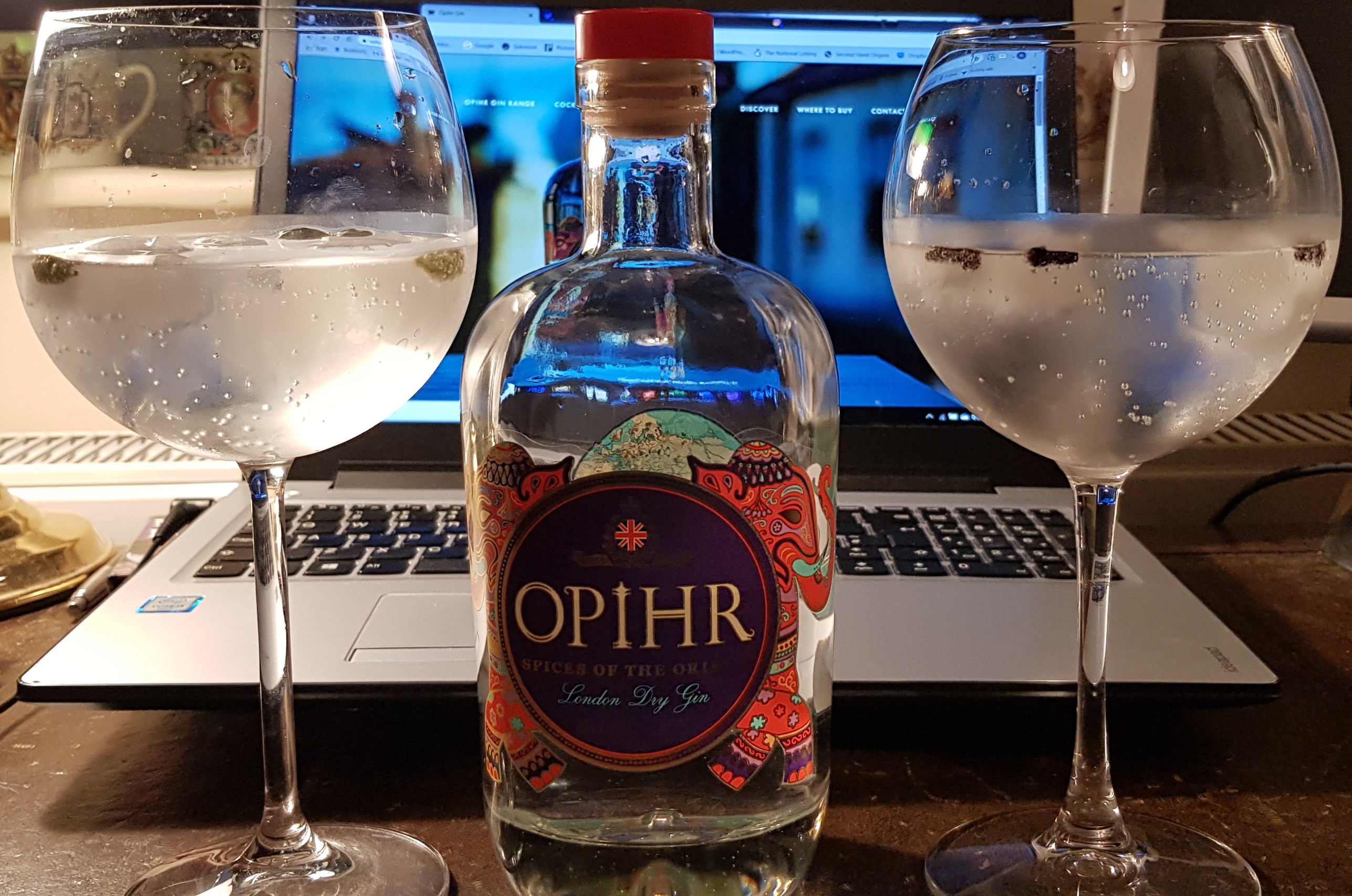
If I am going to review individual gins then I thought I would start with one that really is noticeably different – Opihr. If you were at all doubtful that all these different gins on the market actually have individual tastes then this should absolutely convince you. If you drink this and can’t discern any noticeable difference from what you have drunk before then your palate and tastebuds are officially dead and there really is no hope for you!
Opihr is a London Dry Gin (that’s a style of gin and not a geographical reference – more on that in a future post) with oriental spices. Opihr now produce several variants, but this is a review of the ‘original’ offering (see picture above) which is also the one that you are most likely to find on the supermarket shelves.
For any gin, I do like to have a small taste (and I do mean small) neat. This removes any influence of tonic or garnish and lets you get direct to the flavours in the gin – though I freely admit that some flavours are only brought out when the tonic and garnish are added. Nevertheless, I find this a good place to start. Well, just a quick sniff of the neat Opihr tells you that you are in for something very different. The warm spices are immediately obvious on the nose. In particular, cardamom and coriander leap out at you and when you take a swig (sorry, gentle sip) they are there in bucket loads on the palate as well.
Adding ice and tonic really wakes up these spice route flavours and instantly make this a gin and tonic like you have never tasted before – and I mean that in a very, VERY good way! The blurb on the label (and the website) tells you Opihr (pronounced o-peer) was “a legendary region famed for its wealth and riches which prospered during the reign of King Solomon.” The exact location of Opihr remains a mystery but it is believed to have been in the Orient along the ancient Spice Route. The botanicals used in this gin include cubeb berries from Indonesia, black pepper from India and coriander from Morocco. Well, in actual fact, none of those particular ingredients are that unusual in modern gin. However, whether it is from where they are sourced, or the other botanicals mixed with them or the particular proportions I cannot say, but something makes this exotically spiced gin incredibly distinctive.
So, how do you bring out the best from this riotous carnival of spiced flavours? Well, my two favourite garnishes with this gin are cardamom or cloves (though not together!). If you are not sure you would recognise these flavours, cardamom (the glass on the left in the picture) is one of the main spices in pilau rice and if you have ever neglected to keep your eyes open and have ended up chewing on a whole cardamom pod buried in the rice from your favourite Indian restaurant then you will certainly have known about it! It is like eating raw perfume and can stay with you for hours. Fortunately, adding these pods to your G&T is perfectly safe because, whilst it flavours it beautifully, they are clearly visible so you are not likely to find one in your mouth without due warning. Clove, on the other hand (right hand glass), you are most likely to have come across as the flavour in the bread sauce with your roast chicken or turkey. If you can’t stand bread sauce, but weren’t sure why, best not go for the cloves! If you don’t have either of these to hand then black peppercorns work well. Failing that, dried juniper berries and/or a couple of wedges of lime go with pretty much any G&T and certainly won’t let you down here.
As cardamom is one of the botanicals used in this gin then adding some cardamom pods really brings that out. Take three or four pods, lay them on a kitchen work surface, lay the flat side of a kitchen knife across them and give it a whack with the heel of your hand to crack the pods, thus exposing the seeds, and add them to your iced gin. If using cloves (my absolute favourite for this gin), then just pop in four or five whole cloves. Whatever you do, don’t use ground cloves. That just leaves an unattractive dust on the surface which is unpleasant to drink and doesn’t even noticeably enhance the flavour! Either way, add a suitably bold flavoured tonic (I recommend original Fevertree Indian tonic water – that’s the yellow label) and enjoy.
This is NOT a sponsored post and all the opinions expressed are entirely my own. However, if you want to find them in cyberspace then Opihr does, of course, have a presence on the usual social media platforms:


 The Garden of Will's Delights